Soccer is a popular sport watched and played by millions of people worldwide in various countries. A common question that is asked is “How Many Players Are on a Soccer Team?”
It is crucial to understand the number of players in soccer, as this knowledge helps fans, novices, and young players understand the structure of the game. Depending on the format and level, the number of participants may differ, from professional to youth competitions.
This guide will teach you everything you need to know about the number of players on a soccer team—from the official FIFA rules, through substitutions, player positions, youth soccer variations, and more.
Understanding How Many Players Are on a Soccer Team
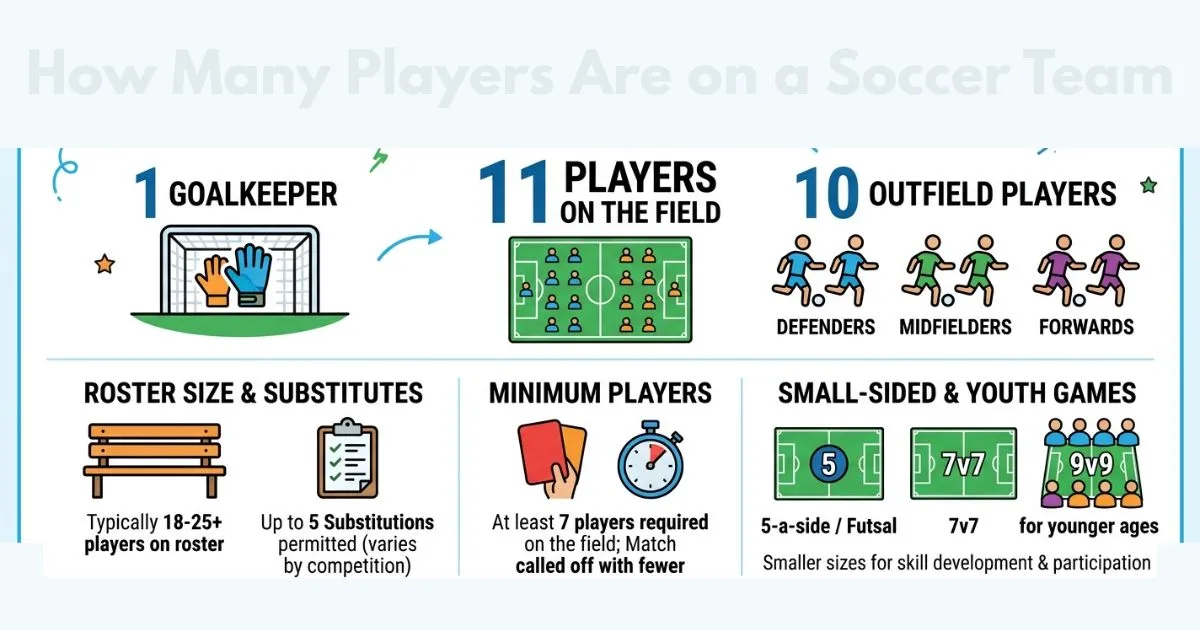
The official answer to the number of players on a soccer team is easy. There are 11 players on a soccer team at a time. This is made up of 10 outfield players and 1 keeper.
In full match play, there are 22 players on the field (11 for each team). It is observed in professional leagues, international tournaments, and in most organised competitions throughout the world.
11 players allow for balance between offence and defence. It enables teams to be set up correctly and still provide a good strategy.
Why Soccer Teams Have 11 Players
The 11-player rule of soccer has been in use for many years. As time went on, football associations came to understand that the ideal number of players on a team was 11.
The field will be too wide open and hard to cover with fewer players. If there are too many players, movement will be crowded, impairing attacking. The 11-player format offers an ideal mix of skill, strategy and action.
Nowadays, FIFA and other organisations officially control the standard soccer player count in soccer across the globe.
The Positions on a Soccer Team
It is important to know the roles of soccer players to understand the number of players on a soccer team. It is helpful to know the different roles of the players in order to understand the number of players on a soccer team.
One goalkeeper is the usual number of players on a team. The goalkeeper is the only player who can use their hands in the penalty box and is responsible for the defence of the goal.
The other ten players are split into defenders, midfielders and forwards. The backline is responsible for defending, the midfielders link the defence and the forwards score goals.
The number of players in each of the zones may vary depending on the formation. Popular formations include 4-3-3, 4-4-2, and 3-5-2.
How Many Players Are on a Soccer Team, Including Substitutes?
While only 11 players can play on the field at one time, teams usually have additional substitute players on the bench.
Professional soccer teams use 7 to 15 substitutes, depending on the rules of the soccer tournament. Coaches can replace tired or injured players during the game using substitutions.
In modern competitions, five substitutions are usually permitted during the normal game. The number can differ depending on the league/competition, however.
That means that a full-strength soccer team can have more than 20 players on the roster even though they only play in 11-man games at a time.
Minimum Number of Players Required
The next rule about How Many Players Are on a Soccer Team is the minimum number of players needed for a game.
Official soccer rules state that there must be a minimum of seven players on the field for a team. When a team is a man down due to injuries, red cards, etc., the match is likely to be called off.
The rule is to ensure fairness and balance in the competition.
Differences Between Professional and Youth Soccer Teams
Youth soccer frequently plays in smaller sizes to facilitate better skill development in the players. More contact time with the ball and opportunities for participation in games for younger players.
For instance, in youth leagues, a 4v4, 5v5, 7v7 or 9v9 system can be used in place of the usual 11v11 system.
The number of players increases as the players get older and their skills develop, leading to a full 11-player game as is found in professional soccer.
These smaller sizes make soccer fun and educational for novices.
How Many Players Are on a Soccer Team in Small-Sided Games?
Small-sided soccer is a very popular type of soccer throughout the world. They are smaller versions of soccer with fewer players.
The most popular format is 5-a-side. There are 5 players per team, with the goalkeeper. Fast-paced and very technical focus.
Another form of indoor football is Futsal, which also uses five players on each side. It is acknowledged by FIFA and played all over the world.
Seven-a-side soccer is also common in amateur leagues and youth games.
How Substitutions Affect Soccer Teams
Substitutions are a fundamental component of soccer strategy in today’s game. Substitutes are used to boost team performance, safeguard injured players and make tactical changes in a match.
When players are tired, fresh players can inject energy and speed into the game. Substitutions are permitted defensively to ensure that a lead is not lost, and attack substitutions are allowed to enhance potential chances of scoring.
While substitutes are valuable, the rule for the number of players on a soccer team is still 11 players on the field.
Soccer Squad Size in Major Tournaments
Large international tournaments typically permit squads to be larger.
For instance, the FIFA World Cup allows national teams to sign over 20 players to ensure their preparation against injuries, suspensions, and tactical adjustments.
But only 11 players will be on the field for the game, and the remaining players will be available as substitutes.
This bigger team structure enables the teams to remain competitive during long tournaments.
How Soccer Formations Use the 11 Players
A coach has to arrange their 11 players in a soccer formation. They play defence, possession or attack in different formations.
A 4-3-3 formation comprises 4 defenders, 3 midfielders and 3 attackers. This system is preferred as it promotes a balance of offensive and defensive skills.
A 4-4-2 formation is a defensive and stable one, featuring 4 central defenders, 4 midfielders, and 2 forwards. In the meantime, a 3-5-2 shape provides more clout in the middle of the field.
In all formations, the number of players remains the same.
Why Team Balance Matters in Soccer
One of the reasons for the question about how many players are on a soccer team is that soccer is a team sport, and it relies on balance and teamwork.
Each player plays a part that contributes to the team’s winning. Defenders stop goals, midfielders find chances, and forwards strike the target.
If one player fails to perform properly, the entire team’s structure can become weak. That is why chemistry and coordination are crucial in soccer.
An 11-player formation enables teams to play in a balanced manner and cover all areas of the pitch well.
Soccer Team Rules Around the World
Soccer rules are generally the same across all national soccer leagues; however, there can be some variations in the number of players per team or in how many substitutions are permitted.
FIFA and other regional football associations guarantee that the rules used in official football matches are the same.
The majority of leagues outside of Europe, South America, Asia and other parts of the world play with the same 11 players. The consistency helps equality in competitions around the world.
These common laws make soccer games accessible to fans around the globe and instantly understandable from the very first kick of the ball.
The Evolution of Soccer Team Sizes
There was not always a specific number of players in the early days of soccer. A range of team sizes was tried at different schools/ clubs.
The 11-man configuration was adopted by sports officials as the game developed in the 19th century.
This design was perfect for field size, player mobility and tactical play. The format has since been pretty much the same.
The 11-player system is intertwined with soccer tradition and strategy these days.
How Many Players Are on a Soccer Team in Women’s Soccer?
Official soccer rules are the same for women’s soccer. There will be 11 players on each team, with one goalkeeper.
Full compliance with FIFA rules on the number of players and substitutions for professional women’s clubs and international tournaments.
Women’s soccer has helped to grow the sport’s popularity among younger people and newer fans.
The same 11-player format is applied to major tournaments such as the FIFA Women’s World Cup.
Soccer Team Sizes in Recreational Games
Depending on the number of players and the room available, team sizes for recreational soccer games are sometimes adjusted.
Parks or school games could be 3v3, 6v6, or any other format that fits the game. These games are played for fun and fitness, not as a competition.
For organised recreational leagues, however, typical small-sided game structures are followed to maintain a level playing field and an enjoyable game.
Knowing the number of players on a soccer team will also assist players in organising well-balanced matches in casual situations.
The Importance of Goalkeepers
The position of goalkeeper is one of the most crucial positions in soccer. Each soccer team has 11 players, 1 of whom is a goalkeeper.
Goalkeepers use reflexes, positioning and communication to protect the goal. They are usually good leaders on the field since they can see the game from behind the defence.
If there were no goalkeepers, teams would not be able to play effectively in defending against attacks and shots on goal.
This is a vital role for any team’s success on the soccer field.
FAQ’s
How many players are on a soccer team during a match?
A standard soccer team has 11 players on the field during a match, including one goalkeeper.
How many substitute players can a soccer team have?
Most professional competitions allow between 7 and 15 substitute players on the bench, depending on tournament rules.
What is the minimum number of players required in soccer?
A soccer team must have at least seven players to continue an official match.
Do youth soccer teams have 11 players?
Not always. Youth soccer often uses smaller formats like 5v5, 7v7, or 9v9 to help player development.
How many players are on a futsal team?
A futsal team has five players on the field, including the goalkeeper.
Why does soccer use 11 players?
The 11-player format creates balance between attack and defence while allowing effective teamwork and tactics.
Conclusion
To sum up, understanding how many players are on a soccer team gives you a clear picture of how the game is structured and played at all levels. There are 11 players per team on the field, with backup players, and governed by rules established by FIFA or other soccer authorities. There are differences in the rules for youth, recreational and small-sided games, but globally, the most common format is the 11-a-side game. This is essential for the fans and beginners to appreciate the teamwork, strategy, and flow of the game in every match.