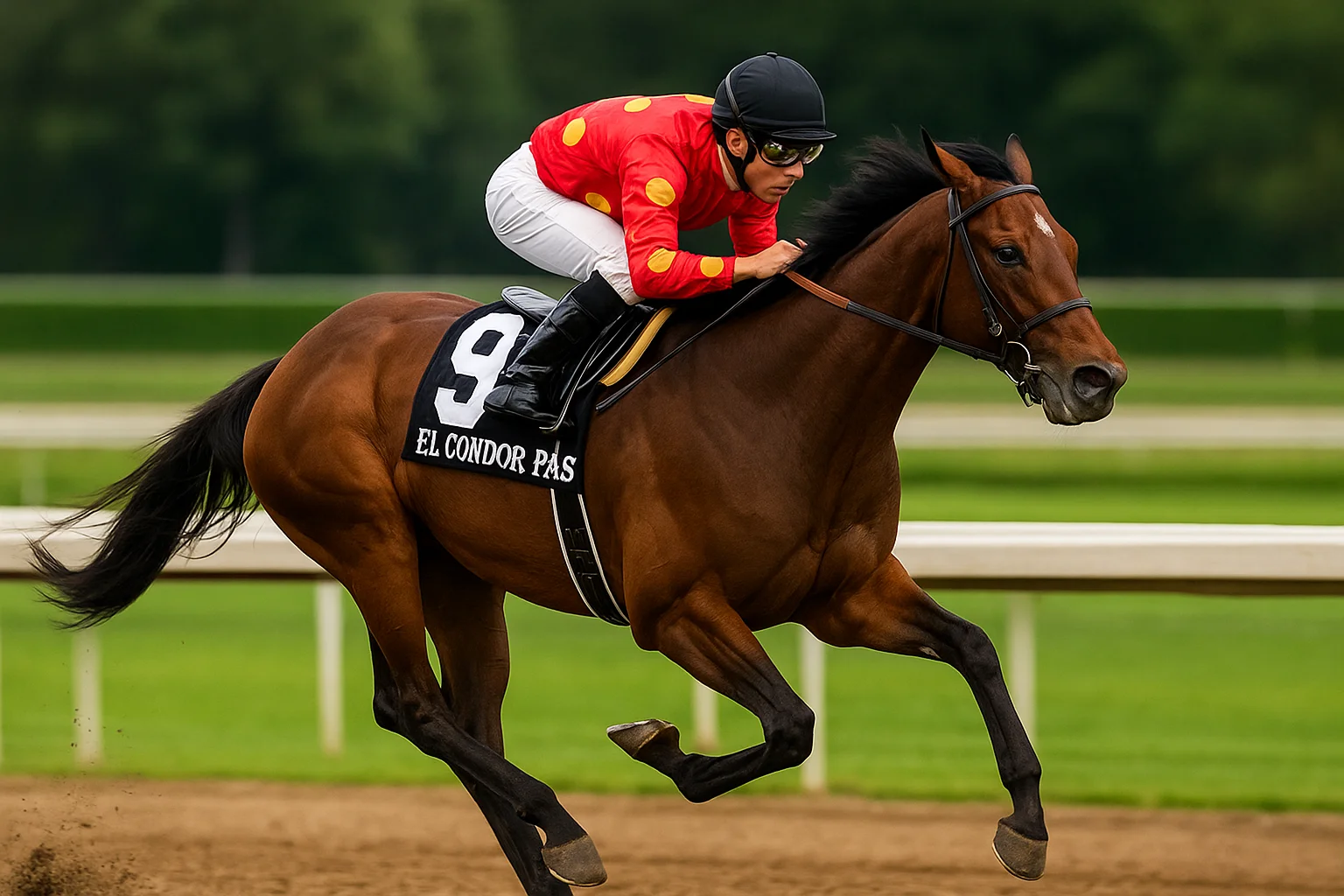
Introduction
The El Condor Pasa horse is a bright horse of Thoroughbred perfection, which is a combination of inherent and inborn skills, craftsmanship of a trainer, and stratagem of racing. He was foaled on March 17, 1995, in Kentucky, the United States, and trained in Japan, and he became an embodiment of international racing.
Nurtured since his days as a foal to become a top-of-the-line competitor in the global arena, he is a tale of careful planning, smart training, and sheer perseverance. His career is commonly used by racing historians and enthusiasts as a model for gaining international racing success.
This paper takes a deep look at his lineage, racing accomplishments, and legacy, with step-by-step explanations that can be of interest to people who love racing, breeders, and even racing industry professionals.
Key Takeaways
- The El Condor Pasa horse won 8 out of 11 races, which is an indication of consistency and flair.
- His major victories include the 1998 NHK Mile Cup and Japan Cup, which make him a very strong horse in the Japanese races.
- Timeform-rated 136, indicating world-class standards.
- After becoming an inductee in the JRA Hall of Fame in 2014, his influence on racing is long-term.
- Sired many successful progeny, such as Vermilion and Song of Wind, so he lives on in Japanese bloodlines.
El Condor Pasa Horse Pedigree: Birth and Bloodlines
The El Condor Pasa horse pedigree is a textbook of the upper-echelon Thoroughbred pedigree. Sired by Kingmambo, a descendant of the legendary Mr. Prospector, and out of Saddler’s Gal, daughter of Sadler’s Wells, his lineage combines American speed with European stamina.
Insiders in the Thoroughbred industry have pointed to his lineage as a pattern to breed multipurpose and flexible racehorses. He was born with athletic potential, conformation, and intelligence, and his future as a champion was foreordained with the right bloodlines being used in his breeding.
Young Years and Education: Educating the El Condor Pasa Horse
The training of the El Condor Pasa horse was done in a well-paced and gradual manner under the keen watch of the trainer Yoshitaka Ninomiya. Starting with short gallops, his practice began to take a longer workout and stamina-building exercises with a focus on mental focus and adaptability.
Anecdotes of stable hands remember him as a calm and eager personality, and thus very responsive to training. Nutrition, exposure monitoring, and close attention to growth milestones were all important characteristics that made him a top-quality competitor. This stage became the foundation of his brilliance in tactics in the domestic and international fields.
El Condor Pasa Horse Racing Record: There Is A New Way To Win In Japan
The El Condor Pasa horse racing record reveals how fast he shot up in Japan. Later on in 1998, he won the NHK Mile Cup, overcoming his rivals with a brilliant late run. He went on to win the Japan Cup, which was a field filled with more experienced horses, but he displayed tremendous endurance and racing savvy to win the race.
Analysts point out that these victories were not only skills-oriented but also the result of planning that took place in terms of race positioning, judgment of pace, and reaction to the actions of opponents. These runs made him the dominant three-year-old in Japan and had him well prepared to compete on the international scene.
The Planning of the El Condor Pasa Horse to Race Abroad: Preparation to Race in Europe
The move to see El Condor Pasa run in European racing was not a blind one. Trainers slowly adapted him to different climates, track surfaces, and styles of racing and started him in minor preparation races. This systematic training made him physically and mentally prepared to play Group 1 European matches.
According to the expert racing strategists, this kind of preparation is usually underestimated, but it is a crucial step to the success of international campaigns. The team strategically planned each move, such as selecting the races, the jockeys, and the horse in a manner that increases his opportunities of delivering his best through careful planning, which is critical in elite horse racing management.
The Condor passes Horse Achievements: Achievements in Europe and Grand Prix de Saint-Cloud
The El Condor Pasa horse’s accomplishments extend far beyond Japan. His win in the Grand Prix de Saint-Cloud showed him to be adaptable, to be able to think tactically, and to have stamina on foreign soil. Commentators on racing commended his skill in following the race, without wasting his strength in the middle of the race, so that he could then burst into the final sprint.
This victory earned him recognition as a global-level athlete and highlighted the tactical prowess of his team. His achievements in Europe not only confirmed the methods of Japanese training on an international scale but also gave future generations of horses and trainers to train to achieve excellence in global racing.
Mythical 1999 Prix de l’Arc de Triomphe: El Condor Pasa Horse in Action
In the 1999 Prix de l’Arc de Triomphe, the El Condor Pasa horse demonstrated his outstanding courage and endurance, and spent a lot of time in the lead. In spite of his finish as a narrow second to Montjeu, this is seen by racing analysts as one of the greatest performances ever seen of a Japanese–trained horse in Europe.
The step-by-step analysis shows his strategic stance, the moment of the final rush, and the capability to keep the peak speed under pressure. His close defeat is still considered a landmark of international horse racing history and keeps inspiring the trainers, jockeys, and other fans all over the world.
The Racing Style and Key Strengths of the El Condor Pasa Horse
The El Condor Pasa racing type was characterized by methodical ability, versatility, and endurance. Be it at the forefront or a late charge, he was a smart race reader. Analysts point out that his mental stamina and flexibility to various track conditions were also as important as his physical qualities.
Racing analysts and breeders frequently refer to him as a standard of what to create in the future in terms of a racing champion because it was a mixture of talent, training, and race sense.
El Condor Pasa Horse Career and Legacy
Upon his retirement in 1993, the El Condor Pasa horse became one of the most popular sires in Shadai Stallion Station, and has developed top progeny like Vermilion and Song of Wind. His legacy lives on in these descendants, who have inherited his quickness, endurance, and flexibility.
To support the breeding programs in Japan, breeders still study the pedigree, performance record, and progeny. His innovations to the racing tactics, both on and off the race track, make him one of the changing figures in international horse racing.
El Condor Pasa Horse is a Fan Favorite. Why?
The El Condor Pasa horse is still winning the hearts of racing enthusiasts because of his impressive performance, bravery on the field, and his inspirational life. His racing career, international campaigns, memorable races in Japan and Europe, and legacy as a sire of champions have cemented his position within the history of racing.
His career as a model of ambition, skill, and perseverance means that fans and experts will continue to celebrate his career as long as it lasts.
Step-by-Step Guide: How to Analyze a Legendary Racehorse with El Condor Pasa Horse
The use of a structured analysis of a horse, such as the El Condor Pasa horse, is important.
- Pedigree Analysis – Examine the lines of inherited speed and stamina.
- Training Regimen – Consider the conditioning programs, work schedules, and nutrition.
- Race Record – Analyse past results, wins, and the level of competition.
- Racing Style – Evaluate strategies, adaptability, and mental toughness.
- Progeny and Legacy – Understand the effects of children in the future.
By doing so, it is possible to get a thorough understanding of what exactly makes a horse legendary, and the El Condor Pasa horse is the one example to use in this case.
Conclusion
The El Condor Pasa horse is one of the epitomes of Thoroughbred excellence. His national and international success, coupled with his success as a sire, clearly make him one of the greatest racehorses of all time. His tale is a permanent reminder of the strength of talent, tactics, and determination, and that offers prudent advice to breeders, trainers, and racing fans.
FAQs
What was the El Condor Pasa horse?
El Condor Pasa horse was a renowned Thoroughbred racehorse foaled on 17 March 1995 in Kentucky, USA ,and trained in Japan. Being a truly great horse, he won 8 out of 11 races, and such prominent competitions as the NHK Mile Cup and Japan Cup.
He is one of the most influential racehorses of his generation, as his near-victory in the 1999 Prix de l’Arc de Triomphe underlined his international competitiveness.
So, what is the pedigree of the El Condor Pasa horse?
The El Condor Pasa horse pedigree is very illustrious. He was sired by Kingmambo, a son of the legendary Mr. Prospector, and out of Saddler’s Gal, whose sire was Sadler’s Wells. This distinctive duality of American speed and European stamina made him an athlete with the versatility to race on different turf surfaces and distances.
His pedigree is used regularly by breeders as a model of good Thoroughbred breeding, with the ability to produce versatile and high-performing racehorses.
What are the most significant accomplishments of the El Condor Pasa horse?
El Condor Pasa’s accomplishments in the horse racing world are those of the horse taking over the NHK Mile Cup, winning the Japan Cup, and winning the Grand Prix de Saint-Cloud in Europe.
He was rated 136 by Timeform, one of the highest ratings of a Japanese-trained horse to compete internationally. In addition to racing, he was an extremely successful sire at Shadai Stallion Station, including Vermilion and Song of Wind.
What was special about the El Condor Pasa horse in racing?
The El Condor Pasa style of horse racing was a tactically adaptable style, a strategic pace, and psychological endurance. His ability to read the race and adjust to various track conditions and distances proved smart, whether it was him going to the lead or making a late run.
His placid nature, tractability to training, and competitiveness enabled him to perform even better than his rivals, becoming an icon of high performance in Thoroughbred racing.
What were the European results of the El Condor Pasa horse?
In Europe, El Condor Pasa horse demonstrated a world-class level of his performance, especially when he won in the Grand Prix de Saint-Cloud. He ran in the 1999 Prix de l’Arc de Triomphe, where he came in a close second behind Montjeu, considered a historic run of a horse trained in Japan.
These successes demonstrated his flexibility, tactical mind, and endurance, which put Japanese racing on a new level in the global scene.